Walking Yunnan — A 23-Day Solo Journey, A Pilgrimage of Faith
Walking Yunnan — A 23-Day Solo Journey, A Pilgrimage of Faith
Foreword: That Lonely Planet and a Long-Planned Escape
In the winter of 2011, Songjiang, Shanghai was bone-chillingly cold. I huddled in a corner of my dorm room after lights-out, covered in hand warmers, clutching a half-cold cup of instant black coffee, surrounded by piles of textbooks and reference materials. The pressure of final exams felt like an impenetrable net, but my eyes kept drifting back to the copy of Lonely Planet: Yunnan on my desk. It stood like a lighthouse, cutting through the darkness of every 3 AM, reminding me: finish your thesis, and you can go to Yunnan.
During that time, "finish your thesis and you can go to Yunnan" became the sole faith of my life. My Lonely Planet was dog-eared from constant flipping, and Yunnan had transformed from a geographical name into a spiritual totem. Like a pilgrim, I stubbornly believed that if I could just endure this bitter period, that land would give me all the answers.
On December 26, 2011, I managed to snag a hard-seat ticket departing on the 30th. Late on the 29th, I put the finishing touches on my last case analysis. At 3:57 PM on the 30th, I sat in Car 5 of the K181 train, my backpack zipped shut with effort, but my heart felt an immense sense of relief.
Forty-two hours in a hard seat was a tug-of-war between body and spirit. I curled up by the small tea table, watching the scenery race by outside the window, drifting between wakefulness and sleep. My legs were swollen, my back ached, but the unknown journey ahead was like a shot of adrenaline, keeping me euphoric through the pain. On the last day of 2011, the train sped southwest; on the first day of 2012, as the train entered Yunnan's borders, I dragged my nearly numb legs and threw myself into the sunlight of Kunming.
In that moment, I knew this trip would be anything but ordinary.
Dongchuan: An Unexpected Gift on the Red Land
A Landscape Almost Missed
Truth be told, I almost gave up on Dongchuan. Two months before departure, I pored over my Lonely Planet, eventually settling on a loop: "Lijiang—Lugu Lake—Deqin—Cizhong—Tacheng—Weixi—Judian—Lijiang." Dongchuan, famous for its red soil, should have appealed to someone like me who harbored a secret passion for photography. But at the time, I was fixated on Meili Snow Mountain. Worried about time, I hesitated and ultimately scratched it from my itinerary.
I consoled myself: It's just a patch of red earth, right? Probably nothing special. I preferred landscapes with stories—what story could red soil possibly tell?
But fate has a sense of humor. When the train entered Guizhou, it started raining. Seeing raindrops on the window in the middle of the night, I told myself firmly: My high school geography tells me Yunnan will be clear and sunny. Yet on the third morning, as the train entered Yunnan, the sky remained gray all the way to Luoping Station. Just as I had completely given up on Dongchuan, the sky outside inexplicably turned blue again. Bathed in Kunming's sunlight, I made a last-minute decision—I'd go to Dongchuan tomorrow.
Unaware of Its Own Beauty
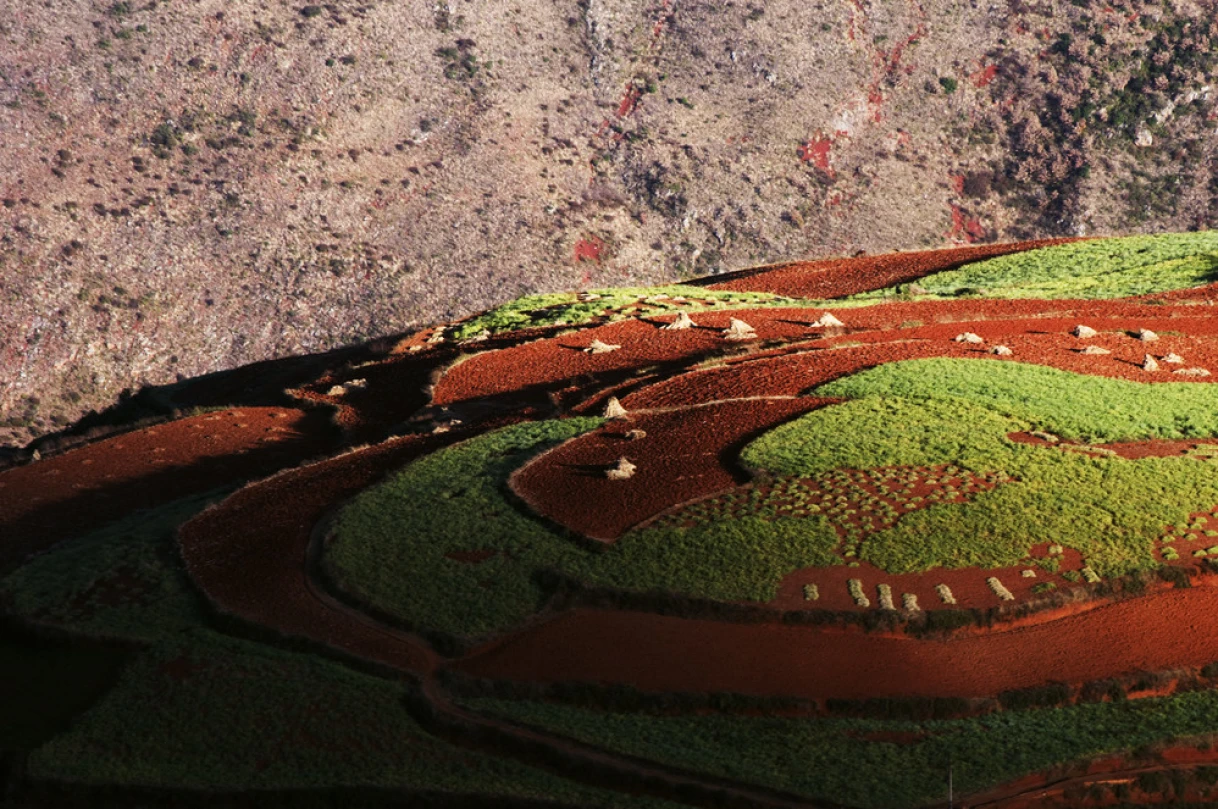
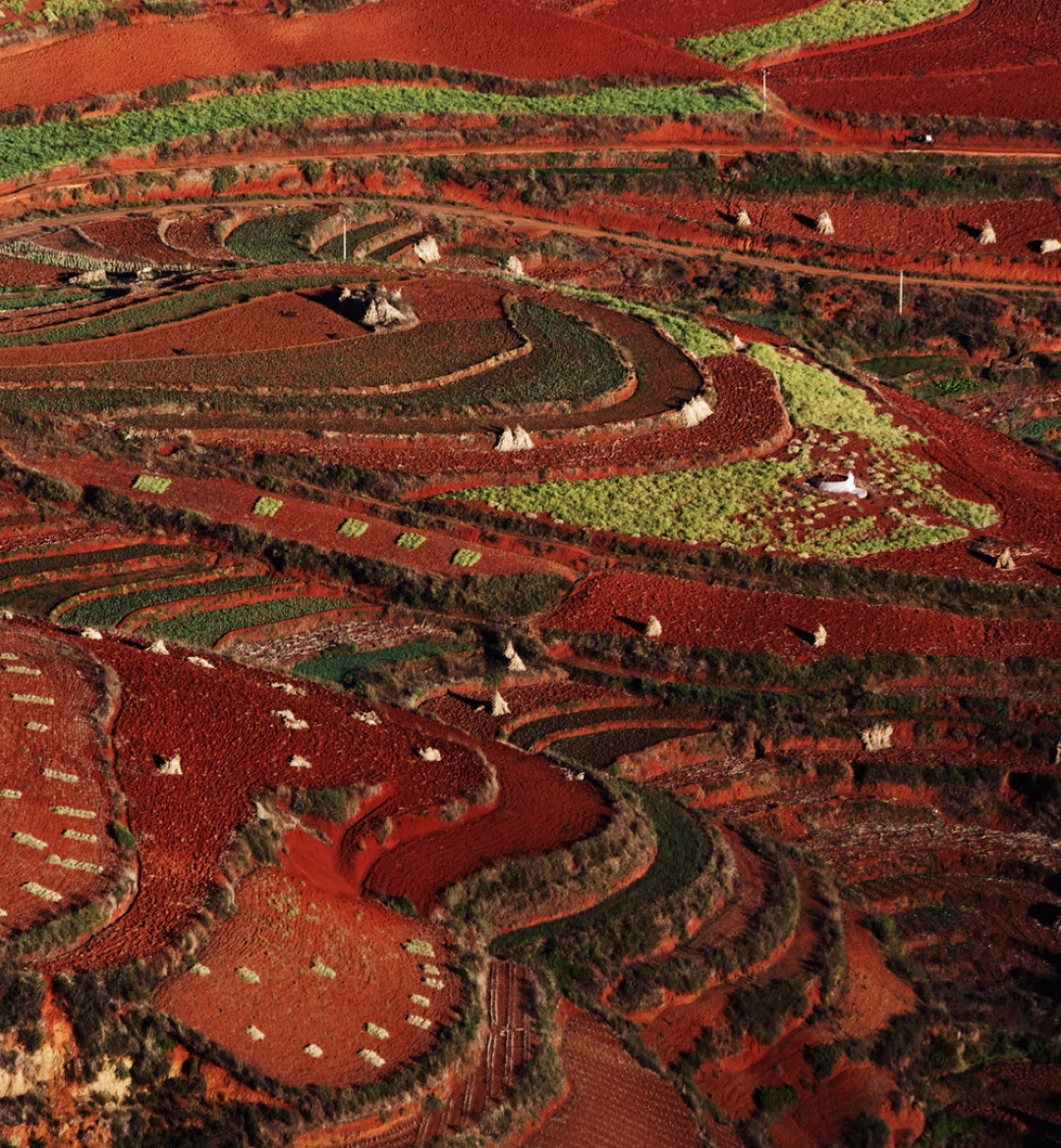
I'm grateful I made that call. Dongchuan's beauty is effortless and unaware. It's like a naturally beautiful girl, so innocent she doesn't realize her looks have captivated everyone who sees her. The scenes that dazzled my eyes and camera all stemmed from the locals' daily farming. On Dongchuan's vast canvas, they labor humbly yet create breathtaking works of art.

The next morning, I planned to photograph the sunrise, but a sudden downpour hit. I stared out the window alone, waiting for the rain to stop. Around nine, the sky finally cleared. The guy traveling with me was still in bed, so I grabbed my camera and headed out solo. The morning wind was strong; I wrapped my head in my windbreaker hood. White rapeseed flowers by the roadside swayed in the breeze. When the wind paused, the silence was broken only by birdsong—clear and melodious, providing the perfect soundtrack to the scene before me.
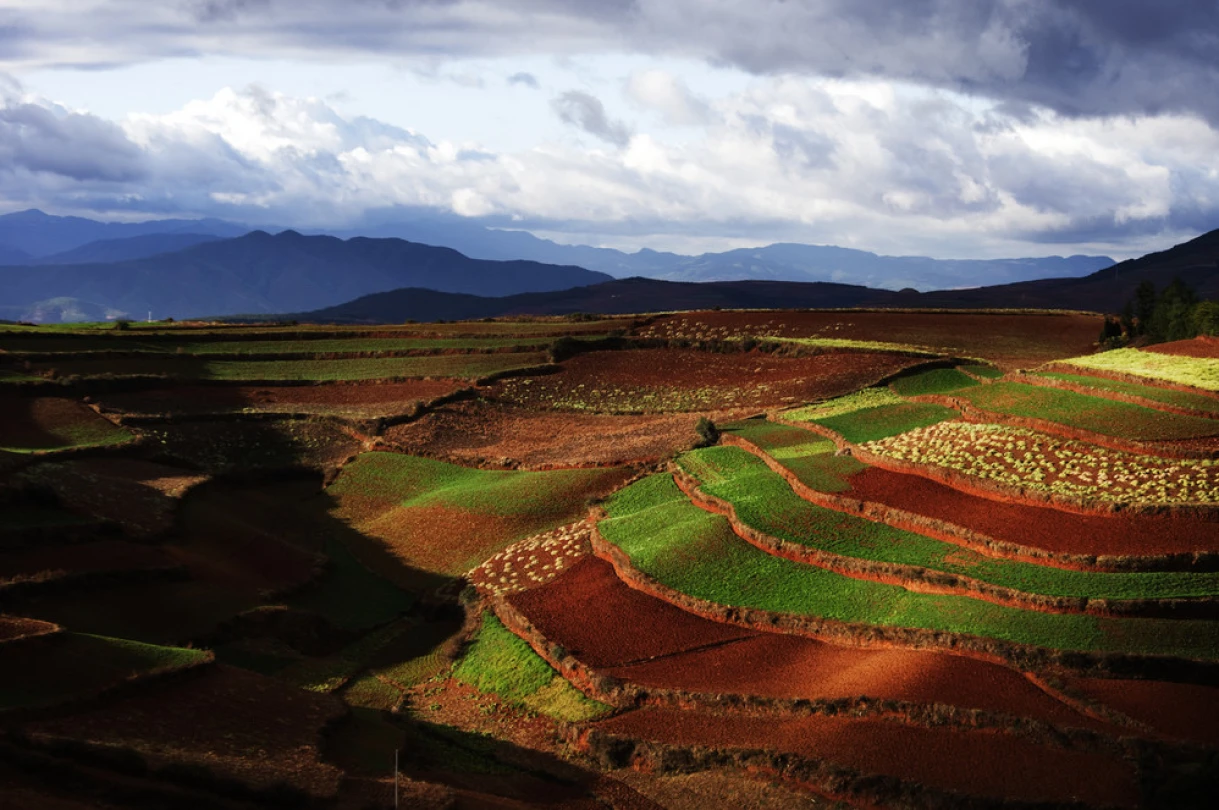
Many people opt for private cars in Dongchuan, but I've always believed the best scenery is found on foot. Under partly cloudy skies, with sunlight appearing and disappearing, I walked contentedly across the red earth. The terraced fields under the sun glowed with colors as thick as oil paint. Distant mountains were shrouded in mist, their hazy gray-blue evoking a traditional ink-wash landscape painting. In that moment, I thought: Perhaps only on Dongchuan's canvas can oil paint and ink wash appear together, merging in such perfect form.
The wind rustled the roadside leaves and ran through my hair. I pulled out my travel journal; the pages tilted gently in the breeze, just like the reeds by the path. Massive clouds drifted overhead, and I could clearly see their beautiful shadows cast across the red land as they passed the sun. The sky felt close enough to touch, the clouds as tangible as sunlight. Above everything, the patches of sky between the clouds were as blue as a lake.
The cattle and horses resting or working by the roadside seemed to understand life better than I did—when they ate grass, they focused on eating grass; when they pulled carts, they focused on pulling carts. Devoted concentration is far more meaningful than idle daydreaming.
The Tenderness Between People and Land
Dongchuan is more than just red soil. Everything here is beautiful—naturally, effortlessly so.
I watched a father loading dried sesame stalks onto a horse-drawn cart in front of his home, while his young daughter held the horse's face and whispered into its big eyes. A schoolboy walking home beside me glanced shyly at me and my camera. Two elderly local women, who barely spoke Mandarin, still smiled warmly at me and gestured for me to come home for tea.
That's Dongchuan. Whether it's the scenery or the people, they are inherently beautiful without knowing it. Casually, with just a word or a glance, they offer the most genuine surprises and touches. You have to believe that in many places in this world, people haven't yet learned to wrap their purest selves in layers. Your smile will absolutely be met with an even brighter one in return.
On the day I left, Dongchuan was hit by heavy snow. I carefully tucked my camera inside my windbreaker, pushed open the hostel door, and stepped out, slipping with every step. The snow was heavy—real goose-feather snow. The road was utterly silent, except for early-rising village dogs barking warily at this stranger. When the dogs tired, I could even hear the snow landing on my jacket. Snowflakes caught on my eyelashes and quietly melted. On the path ahead, a brother and sister walked together; the older sister held a small floral umbrella, carefully shielding her brother and his little schoolbag. They leaned into each other, walking cautiously. The scene reminded me of my own childhood—the mix of nervousness and excitement on snowy school days.
On the bus back to Kunming, I received calls and texts from Shanghai and Tianjin. After replying to each one, I suddenly felt how奇妙 (wonderfully strange) life is. They were in their own worlds, thinking of a 21-year-old girl traveling alone to an unfamiliar place, sending reminders and blessings. And I, the object of their concern, felt none of their worry or tension. People I met along the way found it incredible that a girl was traveling Yunnan alone for over twenty days, but to me, it couldn't have been simpler: one Lonely Planet, one thick skin. Wherever I went, however far I traveled, surprises or difficulties—they were all part of the deal.
The boy sitting next to me was from Dongchuan. He kept looking like he wanted to say something but hesitated. I found his innocence endearing, so I just closed my eyes and pretended to sleep. During a rest stop, he bought two baked potatoes (烤洋芋, roasted local potatoes) and offered me one. I took it and smiled at him. He told me he was 19, working in the city. Then he said, "Sister, you're so brave, coming all this way alone. When will I be able to go somewhere far, like you?"
Lijiang: A Love-Hate Ambiguity
Hate It? Love It?
Do I love Lijiang? Not really. Do I hate Lijiang? Not exactly either.
My relationship with Lijiang is as ambiguous as its nickname, the "City of Romance." One moment I hate it, the next I love it—just like the flirtatious words of the guys who hit on you here: part truth, part lie, so hazy that even they themselves can't tell.
I probably hate it. After being hit on six times in a single day and then encountering a creep in a dark alley late at night, I told myself this place wasn't for me.
But I probably love it too. Even though I felt out of sync with the Old Town (Dayan Ancient Town) from day one, after I moved to Shuhe, I couldn't help taking the bus back just to sit in Sifang Street (Square Street) and soak up the sun. Of all of Lijiang's Old Town, Sifang Street is my favorite spot. There, the same sunlight always feels different.
A Guide to Authentic Lijiang
If you also want to visit Lijiang, try these methods to peel away its flashy veneer and uncover a "fresh and natural" version of the city.
Soaking Up the Sun at Sifang Street Is the Real Priority
Winter in Lijiang means endless sunshine. Just ask any passerby for directions to Sifang Street, follow the cobblestone paths paved with colorful stones, and you'll find a perfect spot for doing nothing. There's always a stone bench in the shade with a seat for you. Since you're in no rush, you can laze away an entire afternoon, chatting with the elderly Naxi women beside you. When you're tired of talking, just doze off in the warm sun. If you don't mind getting a tan, you can shift your position as the sun moves, ensuring a full day of "photosynthesis." If you're lucky, the local Naxi grandmothers will start dancing in Sifang Street in the afternoon. Though they're old enough to be grandmothers, they dance with the joy of children. Their smiles can completely melt you, making you sigh: This is the most genuine Lijiang, the most natural Lijiang.
The Art of Striking Up Conversations
You read that right—I am encouraging you to strike up conversations. But this has nothing to do with so-called "romantic encounters." I'm simply suggesting you proactively and kindly connect with strangers.
Without exaggeration, striking up a conversation is an art. Your attitude must be humble enough, your gaze sincere enough. Find the right topic and respect the other person's communication style. You can compliment an elderly silversmith on his hammering skills, or sit by the street and listen to an old woman at her stall tell stories hidden in her embroidery. Dare to start conversations and be good at it—you'll gain far more than just browsing shops and buying souvenirs.
Beyond hearing stories, chatting people up can help you find friends. In this regard, hostels are another ideal place for striking up conversations. Whether you're looking for a dinner companion or a travel buddy, hostels won't disappoint. Even if you don't usually stay in hostels, their common areas and bulletin boards still offer plenty of opportunities.
Big Flavors in Tiny Shops
There's an unbeatable travel rule: The best things are always on the road. So keep a curious heart and wide-open eyes to create your own surprises. The same goes for scenery as for food.
The saying "Good wine needs no bush" seems especially true in Lijiang's Old Town. Sometimes you have to wander through countless alleys before you find an old woman at a tiny lane entrance handing you a bowl of the most delicious 鸡豆凉粉 (chickpea jelly). The legendary "唠叨坊" (Laodao Fang), famous for its incredible yak hotpot, hides quietly in a corner, perfectly content to make you wander for an hour before you finally "lay eyes on it." Searching for food in the Old Town requires patience and perseverance, along with a spirit of adventure and exploration. A dish that looks ordinary might have an unbelievable flavor; a small shop with no romantic ambiance might hide a taste that awakens your palate.
Inside the City, Outside the City
Wandering through the Old Town—besides daydreaming and chatting people up—exploring the streets and alleys is a joyful treasure hunt. However, when you first enter the Old Town, don't let a love-at-first-sight impulse lead to impulsive spending.
Generally, first-time visitors to Lijiang's Old Town gather on East Street, Qiyi Street, and the middle section of Wuyi Street. Since these are often designated shopping stops for tour groups, these streets are bustling with foot traffic. Consequently, prices here are relatively higher, and there's less room for bargaining. Spread out a map of the Old Town, and you'll realize it's much larger than you think. Many small lanes and alleys are waiting for you in the corners. Don't coddle your legs too much; calm your mind, take a step, and walk from "inside the city" to "outside the city." Leave the city center behind, head to less crowded lanes, and experience a different kind of treasure hunt.
Away from the Old Town center, say goodbye to the endless stream of tourists and quietly step onto the small streets paved with colorful stones. Faint music drifts out of nearby shops. In this quiet, leisurely, uncrowded environment, you can spend an entire afternoon in peace. Hold a bottle of yak yogurt in the sun and watch an elderly artisan carve beautiful woodblock prints, stroke by stroke. The old woman selling 饵块 (Erkuai, rice cakes) at the entrance of Dayan Elementary School always has the gentlest smile. At the shop selling old bells, a popular TV drama might be playing, with the family gathered around the TV, completely unbothered as you photograph the items you love but can't afford. When you pick through keychains in a small bamboo basket, the shopkeeper not only doesn't get annoyed but even brings out a small wooden stool for you to sit on. In these less-frequented alleys, not only are prices lower, but the shopkeepers are also friendlier and more welcoming.
Looking back at this kind of Lijiang trip, even if you eventually forget its scenery or lose the 布农铃 (Bunong Bell) you bought for yourself, at least the beauty of these details will stay with you long after, moving you. This kind of Lijiang trip has nothing to do with ambiguity or alcohol. It's about seeing the original city with your own eyes. In the end, you'll come away with a fresh, natural, authentic Lijiang. Isn't that wonderful too?
Lugu Lake: So Beautiful, So Blue
Love at First Sight
Thanks to the newly paved roads, what used to be a seven-hour drive to Lugu Lake now takes less than five. By evening, I was already sitting quietly in a Mosuo family's grandmother's room, drinking sweet rice wine. The driver, speaking Mandarin with a Mosuo accent, was telling us about local customs and life, his rehearsed spiel taking on a unique flavor.
If I have no one to talk to, I usually can't sit still for long in one place. After finishing my small cup of wine, I picked up my camera and stood up. I snapped photos here and there, but I kept coming back to the old grandmother heating water. The seasons of an entire family were hidden in her authoritative yet loving eyes, making me feel that every wrinkle on her face told a story. For a few minutes, I stared at her, lost in thought: When she was my age, what kind of innocent, beautiful girl was this dignified grandmother? She probably had her moments of helplessness and vulnerability, just like any ordinary girl.
Bored waiting for dinner, I took my camera and stepped outside. In the soft light of evening, the lake slept quietly, gradually receding its unrestrained blue.
On the bus ride there, I sat in the front passenger seat, completely absorbed in the scenery. Compared to Kunming, Dongchuan, and Lijiang, the Jinsha River Grand Canyon was strikingly different: massive clouds wrapped around nameless peaks; beneath one cloud, rain pattered the window; beneath the next, snow might fall. As the bus emerged from one mountain, sunlight instantly illuminated everything.
While I was still lost in this magical landscape, the bus stopped. The driver said we could get off here and see a panoramic view of Lugu Lake from the observation deck. Even though I had mentally prepared myself for the beauty, when I first saw it, I was so excited I nearly tripped over the railing.
It was a magical blue that could silence everything—mysterious and profound. A vast expanse of lake, colored like homespun cloth, lay sleeping in the embrace of the surrounding mountains. I stood in the cold wind, completely speechless. If I had to write something in my travel journal right then, I probably could only write: The lake is so beautiful, the lake is very blue...
A Solo Moment of Emptiness
The evening's arranged activity was a bonfire party—a very touristy affair. My shoes had gotten wet while rowing on the lake in the afternoon, and I was feeling a bit wilted in the cold air. I huddled alone in a corner, watching everyone dance joyfully around the bonfire. Even though I had chosen not to participate, I still felt an inexplicable sense of abandonment.
I often do this—isolating myself when everyone else is having a great time. It's not a good habit, but it's incredibly hard to break. My mood swings become severe during travel. While a group of people danced happily around the warm flames, I curled up in a corner, zoning out. So I'm really not a good travel companion; luckily, I'm self-aware enough to usually travel alone.
After the party, I took the same bus back to Lige. When I didn't feel like talking, I just turned my head to look out the window. A huge moon hung in the ink-blue sky, casting fragmented light onto the wide, quiet lake, like stars falling into the water. I was once again stunned by Lugu Lake's beauty—the kind of beauty unforgettable for a lifetime.
I had wanted to hike around Lugu Lake, but since I had joined a group this time, I couldn't stubbornly insist on walking the entire loop, so I went with the car. When I returned to the hostel in the afternoon, I couldn't bear the thought of just skimming the surface and waiting to leave the next day. Even though a light rain was falling, I grabbed my camera and went out.
Walking alone around the lake, even in the rain, lifted my spirits. I love walking—walking alone. I prefer cobblestone roads to asphalt, and small dirt paths even more than cobblestone. The narrower the road and the fewer the people, the more I look forward to it. Since it gets dark late and there were no forks in the road, I happily walked farther and farther, following dried horse dung to the most remote corners of Lige Village.
It was still early when I headed back, and the rain had stopped. I sat down on a bench by the lake, buried my face in my scarf, leaving only my eyes exposed to the cold wind. The wind was strong that day; the lake, which had been whispering softly, now sang a fast-paced song. I sat there foolishly, listening to the sound of waves lapping the shore. Many emotions surged up like the lake water, then subsided into calm.
"I knew you'd be here," said the 13-year-old girl who had come with the group, as she sat down beside me. We didn't talk much, each lost in our own thoughts. As it got dark, she earnestly recorded the sound of the lake on her phone. I smiled watching her silhouette—so pure, it was truly touching.
Later, she played the recording for me. I heard the beauty of the lake, and the blue of the lake.
Dali: Life Is Like Meeting for the First Time
"Have you put your things away? Let's go get dinner together," called the girl sharing the ten-bed dorm room. I replied and grabbed my bag, heading out the door. Such a natural, friendly conversation—and we had only met less than fifteen minutes ago.
Dali is a very special city. I stayed there for less than twenty hours, yet I accumulated plenty of beautiful, memorable details. As soon as I got on the bus from Lijiang to Xiaguan, I found my assigned seat in the last row. My backpack wouldn't fit in the luggage rack. Just then, the driver, an older man, came to check tickets. He naturally took my heavy bag, carried it off the bus, and placed it in the side luggage compartment. It was as if this dusty-faced girl wasn't a stranger, but his own little daughter he was used to looking after. When I got off to retrieve my luggage, he carefully shielded my head with his hand to prevent me from bumping it on the opening compartment door. Seeing my heavy pack, he took it and patiently helped me put it on my back. In that instant, I was deeply moved.
As I exited the station, several local aunties surrounded me, asking if I needed a ride to the Old Town. Since I was set on going to Nujiang, I casually said, "Not going to the Old Town; I need to transfer to Liuku." I thought this would get rid of them. But as soon as I said it, they earnestly grabbed me and started giving me directions: "Going to Liuku? Buy your ticket at the station ahead. Walk straight for about 200 meters, you'll see a traffic light, see? Go straight, you'll have to look carefully, it's not easy to find. It's on the left side of the road, don't miss it. This direction, got it?" Still not satisfied, they pointed with their fingers to show me. Right then, I fell genuinely in love with Dali.
That night I stayed at the "Spring, Summer, Autumn, Winter" hostel in Dali, a highly recommended place a friend had mentioned. Staying in Dali was unexpected. I had taken a bus from Lijiang to Xiaguan at noon, planning to transfer to Liuku that same day. But I was told the next bus wouldn't leave until around 9 PM, arriving in Liuku at 1 AM. I had to give up, bought a ticket for the next day, and headed to the Old Town instead.
Maybe I should thank that bus schedule. It allowed me to meet a group of wonderful people in the Old Town. They dragged me out for hotpot before they even knew my name, and after they learned it, they stood downstairs calling up to me: "Ah Xuan, come down and chat..."
I remember the poet Nalan Xingde's wish in his lyrics: "Life would be wonderful if it were always like the first meeting." Perhaps in Dali, life is naturally like that first meeting.
The next morning, still half-asleep, I left my seventh umbrella bought in Shanghai on the bus from the Old Town to Xiaguan. Consider it a gift to Dali from this trip—a belated greeting gift.
(On the bus from Lijiang to Dali, I suddenly realized I would never come back this way. I felt a pang of reluctance for Lijiang, even though I had told many people: I don't like Lijiang, I really don't...)
(On the Dali-Lijiang Highway, many villages were incredibly beautiful. I stayed in Dali that night, arriving in the evening and leaving the next morning. Because it rained at night, I gave up on my plan to photograph the night scene. All I have of Dali is this one test shot taken casually from the hostel terrace. Leave some regrets—I think I'll go back someday.)
Laomudeng: The Four-Part Harmony from a Fairy Tale
My Lonely Planet said that the Christian church in Laomudeng holds Lisu-language four-part harmonies every Wednesday and Saturday evening, as well as all day Sunday. I was really looking forward to it. The day I left Xiaguan was a Saturday, so I had to reach Laomudeng that same day.
I found the bank, withdrew cash, and waited at the Liuku bus station at 2 PM. My ticket showed a departure time of 3:20 PM. Doing the math, I started to worry whether I could find a motorized tricycle to Laomudeng after the bus arrived at Pihe.
After passing through security, I waited at the boarding area. Seeing the 2:30 PM bus to Fugong already waiting there, I felt a pang of restlessness...
(To be continued)
Conclusion: A Solo Pilgrimage
Twenty-three days. From Kunming to Dongchuan, from Lijiang to Lugu Lake, from Dali to Laomudeng. I walked the terraced fields of the red land, soaked up the sun at Sifang Street, was stunned by the blue of Lugu Lake, and received kindness from strangers in Dali. Alone, with one Lonely Planet and a thick skin—wherever I went, however far I traveled, surprises or difficulties, it was all part of the deal.
Many people ask me: Aren't you afraid to travel alone? Aren't you lonely? My answer is: When you truly hit the road, you'll discover that there are many people in this world who haven't yet learned to wrap their purest selves in layers. Your smile will absolutely be met with an even brighter one in return. And the scenery you encounter on the road, the people you meet by chance, the unexpected moments of emotion—they'll string together like pearls, forming the most brilliant memories of your life.
What Yunnan taught me isn't how to plan a route or how to save money. It taught me this: Life itself is a journey. You set out with faith, and you return with stories. And the beauty you meet along the way will echo in your heart for a long time, just like the Lisu four-part harmony in Laomudeng.
So, set out. While you're still young, while you still have the courage, while the world is still willing to surprise you.
Key Tips: - Dongchuan Red Land: Best explored on foot; locals are warm and hospitable. - Lijiang's Sifang Street: Sunbathing and listening to Naxi grandmothers sing—free of charge. - Lugu Lake: The newly paved road cuts travel time to 5 hours; most beautiful in the early evening and early morning. - Dali: Stay in a hostel; eating hotpot with strangers is the norm. - Laomudeng: Saturday evenings feature Lisu four-part harmonies at the church—not to be missed.
You should also read:

Solo in Yunnan: A Wanderer’s Guide to the Land of Eternal Spring
Solo in Yunnan: A Wanderer’s Guide to the Land of Eternal Spring There’s something magical about traveling alone. No compromises, no schedules to keep, no one to please but yourself. I’ve been on the road for nearly three months now, and not once have I…
Continue reading...
Into the Hidden Valley: A Solo Journey Through the Mysterious Dulong River
Into the Hidden Valley: A Solo Journey Through the Mysterious Dulong River Deep in the northwestern corner of Yunnan Province, tucked away from the modern world, lies a place that feels like a secret whispered among mountains. The Dulong River Valley is not just a…
Continue reading...
God’s Abandoned Palette: A Self-Drive Journey Through Yunnan’s Dongchuan Red Land
God’s Abandoned Palette: A Self-Drive Journey Through Yunnan’s Dongchuan Red Land Travel has never been about reaching some distant geographic coordinate. It’s about encountering, along the way, the version of yourself buried beneath the rubble of daily routine. During this May Day holiday, I finally…
Continue reading...