Wandering in Xishuangbanna: A Slow Solo Journey, Finding Myself Among Starlight and Pagodas
Wandering in Xishuangbanna: A Slow Solo Journey, Finding Myself Among Starlight and Pagodas
When the innkeeper casually recommended a restaurant, I actually treated it like my own personal cafeteria and ate there for three consecutive days. Because of a single photo by the photographer known as Tibetan Fox Xiaoliang, I rushed without hesitation to the Chinese Academy of Sciences Botanical Garden — a place many dismiss as "overrated and not worth the trip." With plenty of time on my hands, I even did something I never do: I lay in my hotel room for half a day, doing absolutely nothing.
This trip had no itinerary, no plans — only a heart yearning to wander. If you're tired of checklist-style travel, follow along with my rambling account and see what one person can discover in Xishuangbanna.
Departure: The View Outside the Window Is the Most Exciting Ticket
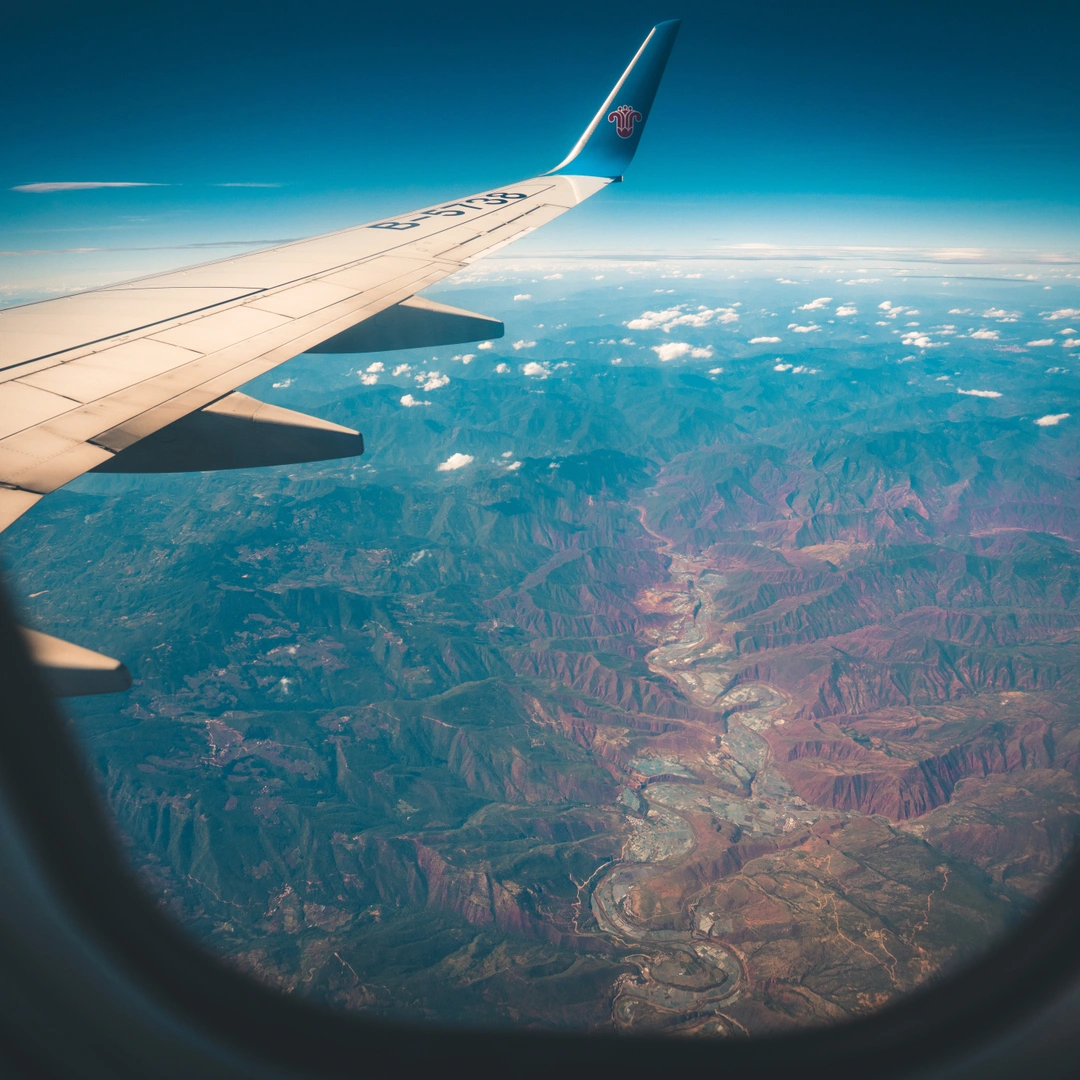
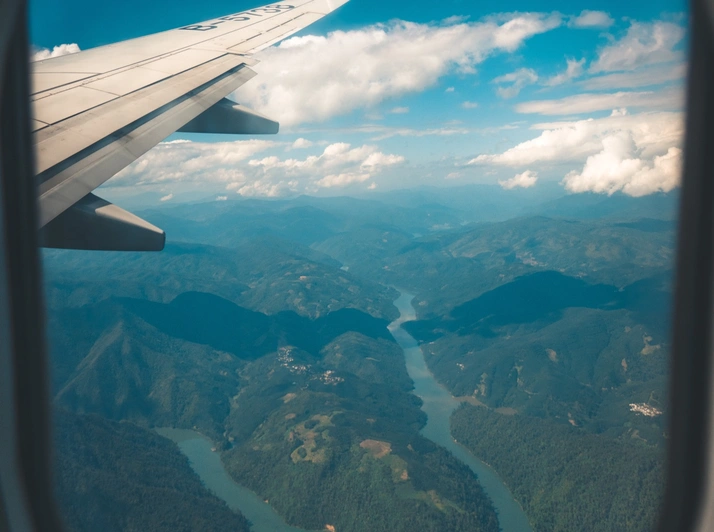
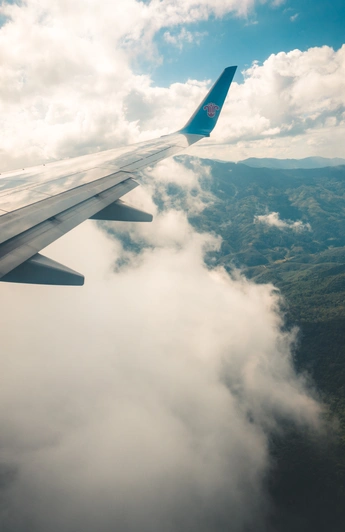
With frequent flights in the second half of the year, I got the idea to shoot a series of "out-the-airplane-window" photos. So this time, I specifically chose a window seat near the back, hoping to capture something unexpected.

To be honest, after working for so long, I'd lost the habit of looking out the window. But solo travel is like that — boring and fascinating at the same time. I remembered something a famous photographer once said: "Your plane ticket is the most exciting ticket of the whole trip, because you never know what you'll see outside the window." So I kept my camera ready, and sure enough, I caught a surprise — a massive U-shaped river bend, a perspective no drone could ever capture.
After flying over a tea plantation, the plane landed. Although Xishuangbanna isn't Pu'er, it's equally famous for producing excellent tea. This land has good mountains and good water, so naturally the tea is good too.
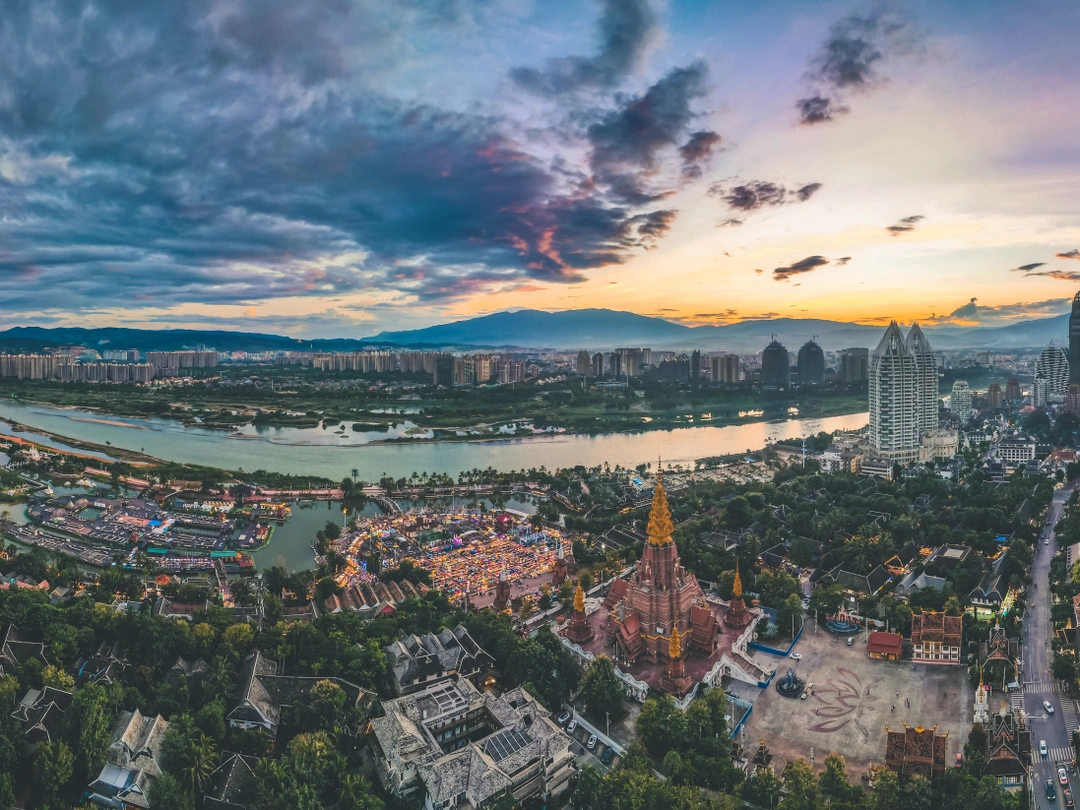
"Xishuangbanna" comes from the Dai language. "Xishuang" means twelve, and "Banna" refers to an administrative unit that provided feudal tribute. Together, it means twelve administrative regions. The capital, Jinghong, is split in two by the Lancang River, and the liveliest area is Gaozhuang Xishuang Jing — meaning "Nine Pagodas and Twelve Villages" — nestled beside the Lancang River and serving as the first stop for visitors arriving in Xishuangbanna.
Rooftop Views: Seeing the City from Above
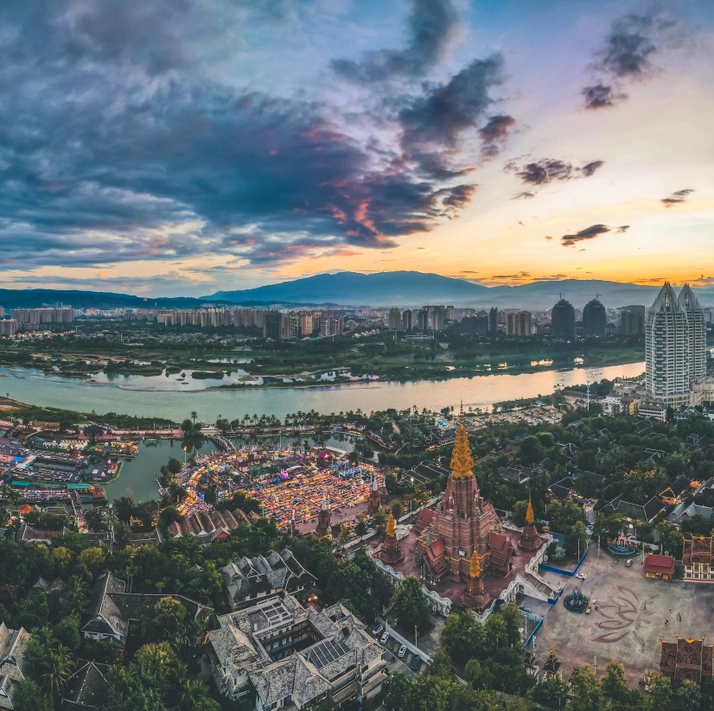
First Impressions of Gaozhuang: Head Straight for the Rooftop
Xishuangbanna's airport is close to the city — just a 15 to 20-minute taxi ride. As soon as I got out of the airport, I regretted wearing too many layers. The driver was in a short-sleeved shirt, while I was bundled in a hoodie. A perfect first impression of a winter escape destination.
At 3 p.m., I arrived at my hotel near the Starry Night Market in Gaozhuang. I dropped my luggage and immediately headed for the only thing I'd actually researched: a rooftop photography spot. Gaozhuang's location is awkward — it's close to the airport and falls within the no-drone zone. Drones can only fly in roundabout ways here, so I'd scouted a few high-rise spots and packed my tripod and telephoto lens.
Building Jingkuangzhai, 29th Floor: First Glimpse of the Starry Night Market
Getting up was surprisingly easy. The lobby has a hotel front desk, but you can just ignore it and head straight for the elevator to the 29th floor. When I got out, I didn't even need to use the fire escape — I was directly on the rooftop.
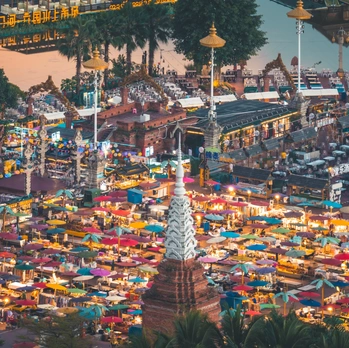
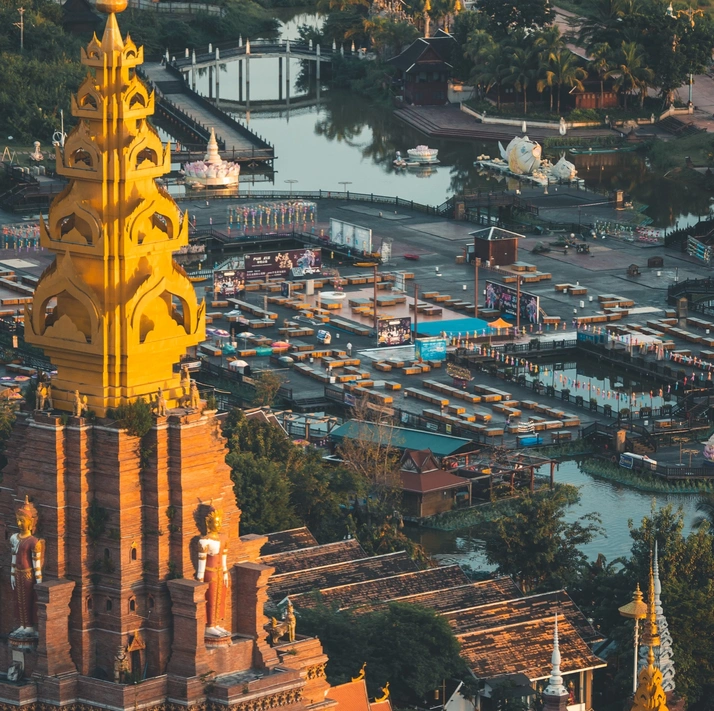
This spot offers a diagonal view of the Great Golden Pagoda and the night market, and the angle was just right. When I first arrived, the sun was still high. I set up one camera for a time-lapse and switched to a telephoto lens on the other to start capturing shots. The light gradually softened, like a warm, sheer veil settling over everything.
Behind the Great Golden Pagoda, the Mekong River Jinglan Grand Hotel stood tall and imposing, its pure white walls and golden roof exuding a Southeast Asian charm. In the distance, a red arch bridge under construction across the Lancang River promised to become a popular photo spot soon.
Around 4 p.m., vendors began arriving one by one, preparing for the day's work. Without the crowds, the night market was as quiet as a secret.
Building Jingzaizhai, East Tower, 39th Floor: The Best Spot
I learned about this location from a local photographer I met while shooting at Jingkuangzhai. He was also photographing the sunset and kindly shared a few good spots.
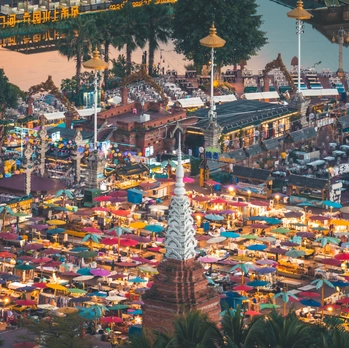
Note: This is a twin-tower structure, and I walked around the ground floor for ages before finding the entrance to the East Tower. There are two elevators — one for the hotel and the other for residents to access the East Tower. You need the residents' elevator to reach the 28th floor. After that, you climb one more flight of stairs via the fire escape.
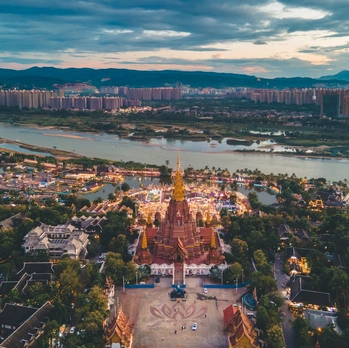
This spot gives you a front-side diagonal view of the Golden Pagoda and the night market. For the pagoda especially, you can capture the Buddha statue head-on. If you only climb one building in Xishuangbanna, I recommend this one. Unfortunately, the weather wasn't great that day. I had my big camera set up for time-lapse and missed many beautiful moments of good light.
I shot the time-lapse until the lights came on, then switched to my telephoto lens and captured a few shots of the Great Golden Pagoda in the evening glow. The night market sprawled beneath a sea of colorful umbrellas, and the Starry Night Market's evening had officially begun.
Starry Night Market: Two Worlds, Day and Night
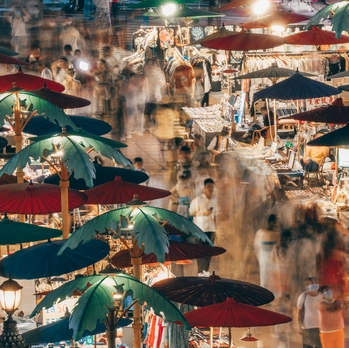
When Night Falls, the Stars Shine
The market is open from 5 p.m. to 11 p.m. Located behind the Jinghong Great Golden Pagoda, the Gaozhuang Starry Night Market is the most iconic attraction in the area. In the evening, you'll see visitors everywhere dressed in traditional Dai clothing for photos. You can also buy handmade crafts and Southeast Asian street food.
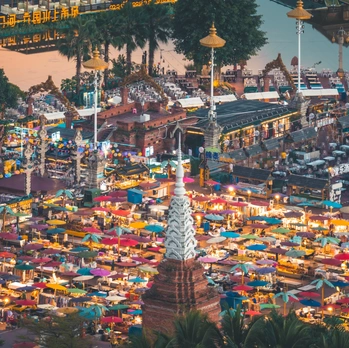
The Gaozhuang Xishuang Jing night market is huge. Walking from one end to the other without stopping takes at least ten minutes. You need to scan a QR code to enter, but there's no admission fee — as long as your health code is green. Honestly, the pandemic has hit the tourism industry hard. The Starry Night Market has shrunk noticeably, and many stalls in the waterfront section have stopped setting up.
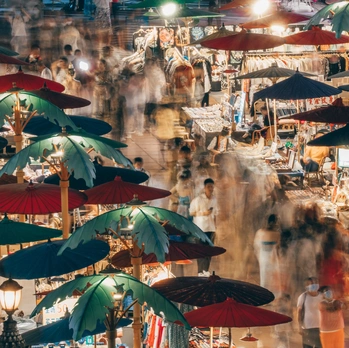
Under the elephant sculptures in the market, hundreds of small stalls open beneath colorful oil-paper umbrellas. The place is packed with people, and on the platform beneath the Great Golden Pagoda, many live-streamers are broadcasting. The market sells mostly ethnic clothing, handmade crafts, and Southeast Asian food. If you take your time browsing, you're bound to find something interesting.
I climbed up to the platform to see the Great Golden Pagoda up close. At night, illuminated by lights, it's resplendent and sacred. Unfortunately, it was cloudy for several evenings, so I couldn't see any stars. Otherwise, capturing a star trail here would have been stunning.
The Starry Night Market by Day: A Different Kind of Beauty
I slept in for an hour. When you're traveling alone, you don't need a fixed schedule. I took my time making coffee, eating breakfast, putting on a little makeup, and changing into a dress before heading out — to see what the Starry Night Market looks like in the daytime, after a night of revelry.
I took a photo with the Great Golden Pagoda, choosing a low angle. The pagoda is the tallest structure in the area, aside from the twin towers. No matter where you walk, you can always see it.
The Jinghong Great Golden Pagoda in Xishuangbanna — also known as the Myanmar Great Golden Pagoda — stands 66.6 meters tall, symbolizing one river (the Lancang) connecting six countries. It's one of the "Nine Pagodas" of Gaozhuang Xishuang Jing and houses a museum of palm-leaf scriptures. It has four entrances facing east, west, north, and south — respectively toward China, Thailand, Laos, and Myanmar, symbolizing the unity of Han and Dai peoples.
On each of the four sides, a dragon staircase descends. The dragon bodies are intricately carved, white in color, with scales decorated with colorful crystal chips. Guardian spirits with human faces and animal bodies stand watch, and Buddha images line every level.
Staying nearby had its perks: I passed by here every time I went out. One morning, I saw a monk practicing shadowboxing on the steps. We exchanged smiles and went our separate ways. Another time, I saw two elderly monks sitting on the steps with tropical fruit beside them. They turned their heads at the sound of my footsteps and smiled at me again. It was a beautiful scene, but I didn't raise my camera. Sometimes, lifting the camera takes away that sense of intimacy.
Chinese Academy of Sciences Botanical Garden: Going for a Single Photo, Embracing the "Overrated"
Having lived in Guangxi, the CAS Botanical Garden didn't hold much appeal for me — we have almost everything they have back home. I really wanted to visit the village featured on the show Back to Field, but during the off-season, I couldn't find anyone to share a car with. I wasn't interested in the animal-themed attractions either, but coming to Xishuangbanna and not going anywhere felt wrong.
So I went anyway. The weather wasn't cooperative — the sun only came out as I was leaving. I didn't rent a car. Instead, I booked a day tour and explored on my own after arriving. Tip: You can book a "Haoxing" day-trip transportation ticket at the Xishuangjing Visitor Center, which includes round-trip bus fare and admission. I didn't get the sightseeing car; I walked.
Xishuangbanna has the best-preserved tropical ecosystem in China, home to one-sixth of the country's plant species and one-quarter of its animal species. Once inside, I headed straight for the famous "Instagram tree." Sure enough, social media filters are real — I did my best with the photo.
November in Xishuangbanna, and flowers are still in bloom. Golden cassia flowers, palm trees, little Dai-style pavilions... One of the garden's main attractions is the giant Victoria water lilies. This isn't their peak season (July to August is best), but they can grow up to 3-4 meters in diameter, with a single leaf capable of supporting up to 70 kilograms. In summer, there's a weight-bearing experience; now, you can only pay a small fee to walk on a bamboo boardwalk for a closer look.
The Victoria water lily's flower "changes three times in three days." Each day, it's a different color: on the first evening, white with a fragrant scent; on the second, pink; on the third, purplish-red. Then it closes and withers. It's known as the "fickle goddess."
The most worthwhile section was the Shade Plant Garden. Beneath towering trees, medium and small plants thrived. The sago palm has a history of over 300 million years — seeing it made me think of dinosaurs. I also caught a photo of a small dragonfly, and some curly plants were quite amusing.
The purple-haired slipper orchid had a hint of purple, with clear orchid characteristics. The pagoda ginger showed two different stages of life — one ancient and weathered, the other youthful and fresh. The Rare Flowers and Exotic Plants Garden was full of unusual species, though about a third of it was closed due to a large beehive — proof of the area's excellent ecology.
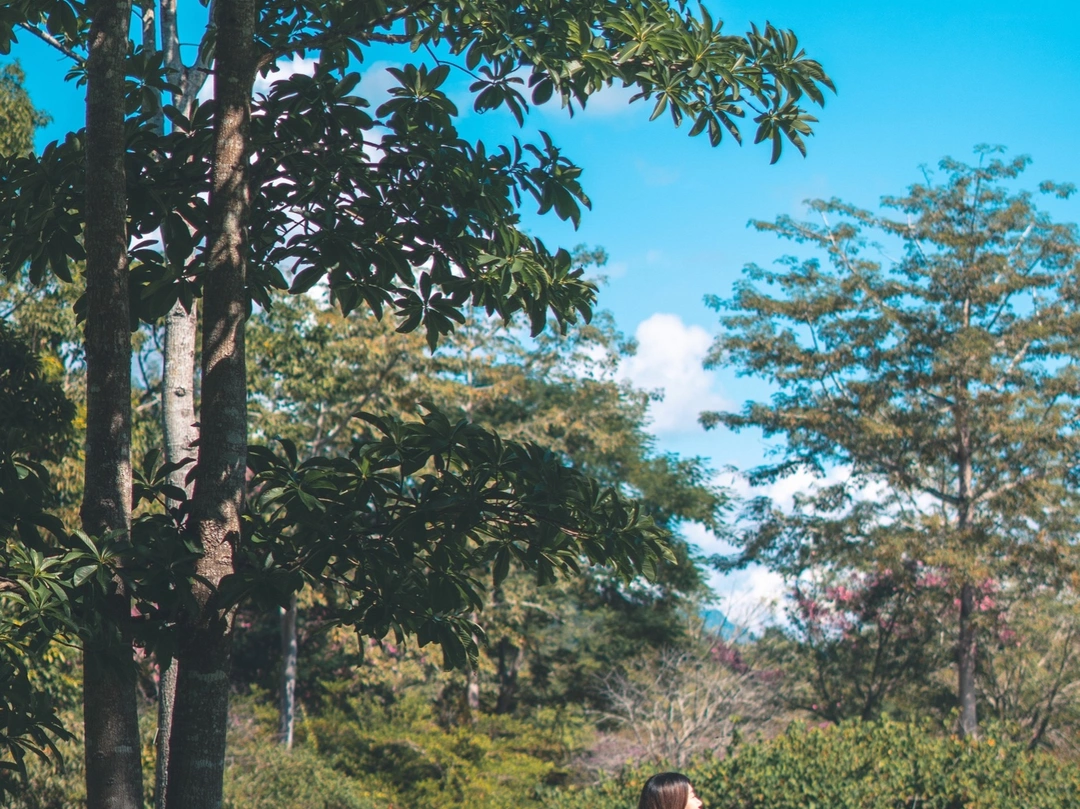
Back at the entrance near the fountain, the combination of plants and small tables and chairs was very pleasant — except for the biting ants. I got bitten twice, and it hurt. A tree with no leaves but covered in purple flowers was stunning. In the morning, there was no blue sky or sunlight, so I had to reshoot everything. The photo I finally chose came at the cost of at least 20 rejects — I'd worn the wrong color dress.
Manting Park and the General Buddhist Temple: A Thousand-Year-Old Royal Garden, the Power of Faith
Manting Park: The Dai King's Royal Garden
Admission: 40 yuan. Manting Park is the oldest park in Xishuangbanna, once the royal garden of the Dai kings, with a history of over 1,300 years. Legend says that when the Dai princess visited, she was so captivated by the beauty that she lost her soul — hence its name. "Manting" means "slave village for flower growers," and "Chunhuan" means "soul."
I couldn't make sense of the map after entering, so I just wandered. To the left of the entrance is the Dai King's Palace, a two-story building. The first floor displays the Thai king's throne; the second floor is off-limits. The main colors are gold and red, distinctly Dai-style.
I passed through a grove of bougainvillea — here, they grow as tall as trees — and arrived at a café. A large lawn, a popular Instagram spot, was covered with tables and chairs, likely for an outdoor wedding. I noticed two red pagodas on the café's rooftop — a great photo spot that almost every passerby stopped to shoot. Using a tripod is tiring, but this time, it really paid off.
After crossing a bridge, I reached the White Pagoda and the General Buddhist Temple. The view from the bridge was beautiful too. The phoenixes and dragon heads on the rooftops were strikingly different from those in the Forbidden City — each with its own charm.
The Earth Goddess fountain is quite famous, representing the long history of Buddhist culture and symbolizing peace. Many visitors wash their hands here to wash away bad luck and bring good fortune.
The White Pagoda in Manting Park is a replica of the Manfeilong White Pagoda. The original Manfeilong White Pagoda, built in 1204, consists of one mother pagoda and eight smaller ones and is a nationally protected cultural relic.
The General Buddhist Temple: The Highest-Ranking Temple
Xishuangbanna's General Buddhist Temple is the highest-ranking temple in the region and is connected to Manting Park. Visiting the temple alone is free, but if you enter from Manting Park and then try to return, you'll need to show your ticket again.
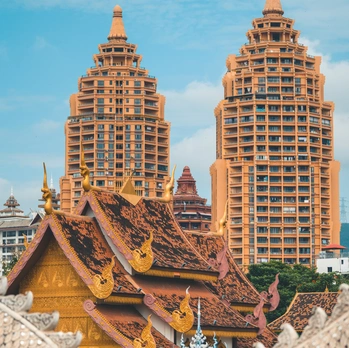
The General Buddhist Temple is the center of worship for Buddhist followers, with a history of about 700 years. It was designated as the highest-ranking temple by the Xishuangbanna Xuanwei (a historical administrative official). Over the centuries, it has produced many eminent monks and enjoys great prestige among Theravada Buddhist followers throughout Southeast Asia.
Strolling through Manting Park was relaxing, but the moment I stepped into the General Buddhist Temple, I felt a sense of solemnity — that's the power of faith. The main hall is flanked by a bell tower and a drum tower. Visitors used to be able to go up, but after they became popular Instagram spots, the monks probably weren't too happy, so now access is restricted. Prominent signs have been placed at the popular photo spots, restoring the temple's tranquility.
The giant Buddha statue at the General Buddhist Temple is incredibly majestic. From different angles, its expression changes. I've always enjoyed paying attention to rooftop decorations — the Dai-style roofs are truly splendid. An old building with a long history still stands, its roots intertwined with the structure. A bird-dropped seed had taken root on the building itself.
Food Recommendations: My Personal Cafeteria
Wantai · Lao-style Iced Coffee: You can't get coffee here after noon. In the evening, while strolling through the night market, I ordered the wildly popular coconut ice in a woven basket. It was a bit too much for one person, but the coconut flavor was rich. Overpriced, though.
Kutai: After a day and a half in Xishuangbanna without finding anything good to eat, a taxi driver recommended this place. It became my cafeteria for the next two days. I tried almost all the local specialties. The online set meals are a good deal, and the quality is consistent. The curry rice dishes are perfect for one person. The pounded chicken feet aren't super tender but taste good, and the basil beef has that authentic Southeast Asian flavor.
Chain Restaurant Crossing-the-Bridge Rice Noodles: I tried it after my rooftop shoot, but it was just average and more expensive than Kutai. Not worth it.
Suggested Itinerary and Accommodation
Day 1: Arrive in Xishuangbanna – Rooftop photography – Starry Night Market
Day 2: Starry Night Market by day – Great Golden Pagoda – Rooftop photography
Day 3: Full-day trip to CAS Botanical Garden
Day 4: Manting Park – Grand Buddha Temple – Departure
Accommodation: I stayed at the Rainforest Secret Riverside Inn, right next to the Starry Night Market. It had a small balcony. On not-too-warm evenings, I'd eat takeout from the market and have a drink while watching the young crowds pass by — it had a certain charm. The twin towers I climbed also have hotels with great views. If you like high-rise buildings, keep an eye out for those.
Conclusion: Solo Travel — Boring and Fascinating
This trip to Xishuangbanna had no packed schedule, no must-see attractions. Because the innkeeper recommended it, I turned a restaurant into my cafeteria. Because of a photo by Tibetan Fox Xiaoliang, I visited a botanical garden others called "overrated." Because I had plenty of time, I spent a good while just lying in my hotel room.
Solo travel is like this: you can wait two hours on a rooftop for a sunset, or you can wander aimlessly through a night market. You can exchange smiles with a monk, or chat with a stranger about photography spots. You don't have to accommodate anyone — you only have to listen to your own heart.
If you want to have a wandering trip like this, remember: your plane ticket is the most exciting ticket, and the view outside the window is always worth looking forward to. And Xishuangbanna — this land nourished by the Lancang River — always has a corner somewhere where you can find yourself again.
About the author: An operations manager who can't translate Vietnamese but is a good photographer. Weibo: @婷仔_dinhoidinh
You should also read:

Solo in Yunnan: A Wanderer’s Guide to the Land of Eternal Spring
Solo in Yunnan: A Wanderer’s Guide to the Land of Eternal Spring There’s something magical about traveling alone. No compromises, no schedules to keep, no one to please but yourself. I’ve been on the road for nearly three months now, and not once have I…
Continue reading...
Into the Hidden Valley: A Solo Journey Through the Mysterious Dulong River
Into the Hidden Valley: A Solo Journey Through the Mysterious Dulong River Deep in the northwestern corner of Yunnan Province, tucked away from the modern world, lies a place that feels like a secret whispered among mountains. The Dulong River Valley is not just a…
Continue reading...
Tengchong·Heshun: Finding Life as It Should Be in a Border Town Where Time Stands Still
Tengchong·Heshun: Finding Life as It Should Be in a Border Town Where Time Stands Still The long journey of over twenty days was over. On my first day back at the office, I was still in a daze. My fingers couldn't find the keys on…
Continue reading...